In the 1990s, a wave of research changed how parents thought about early childhood. Developmental scientists demonstrated that early experience is critical for brain development and that enriched environments support children’s cognitive growth (Ramey & Ramey, 1998). The message was clear: Early experiences matter. What followed, however, could be considered a cultural overcorrection. Baby Einstein videos. Mozart for infants. Activity gyms, sensory toys, and structured play schedules designed to give babies the richest possible developmental diet. The underlying assumption was attractive: If some experience is good, more must be better. It didn’t work out that way. Studies showed that Baby Einstein babies learned no more language than babies who didn’t watch—and some learned less, likely because videos can’t provide the contingent, back-and-forth responding that a live caregiver does (Zimmerman et al., 2007). Ordinary home environments and responsive caregiver interactions were sufficient. Beyond a modest threshold, more stimulation didn’t produce proportional gains. Development is remarkably resilient.
New research from Tajikistan makes a strikingly similar point about motor development and early learning. Across Central Asia, it is common practice to swaddle infants tightly in a traditional cradle called a gahvora (Figure 1) for most of the day and night during the first two years of life (Karasik et al., 2018, 2023). At three months of age, many infants spend most of the day and night in the gahvora, their arms and legs immobilized with broad cloth bindings with brief windows outside the cradle for cuddling, feeding, and social interaction. From the perspective of Western developmental psychologists, this practice sounds alarming. (We know this because many expressed their alarm.) Modern theories of motor development emphasize that infants learn through movement—that they need to kick, reach, bat, and wiggle to discover how their bodies interact with the world (Adolph & Hoch, 2019; Campos et al., 2000). Without that physical freedom, shouldn’t infants’ development suffer?
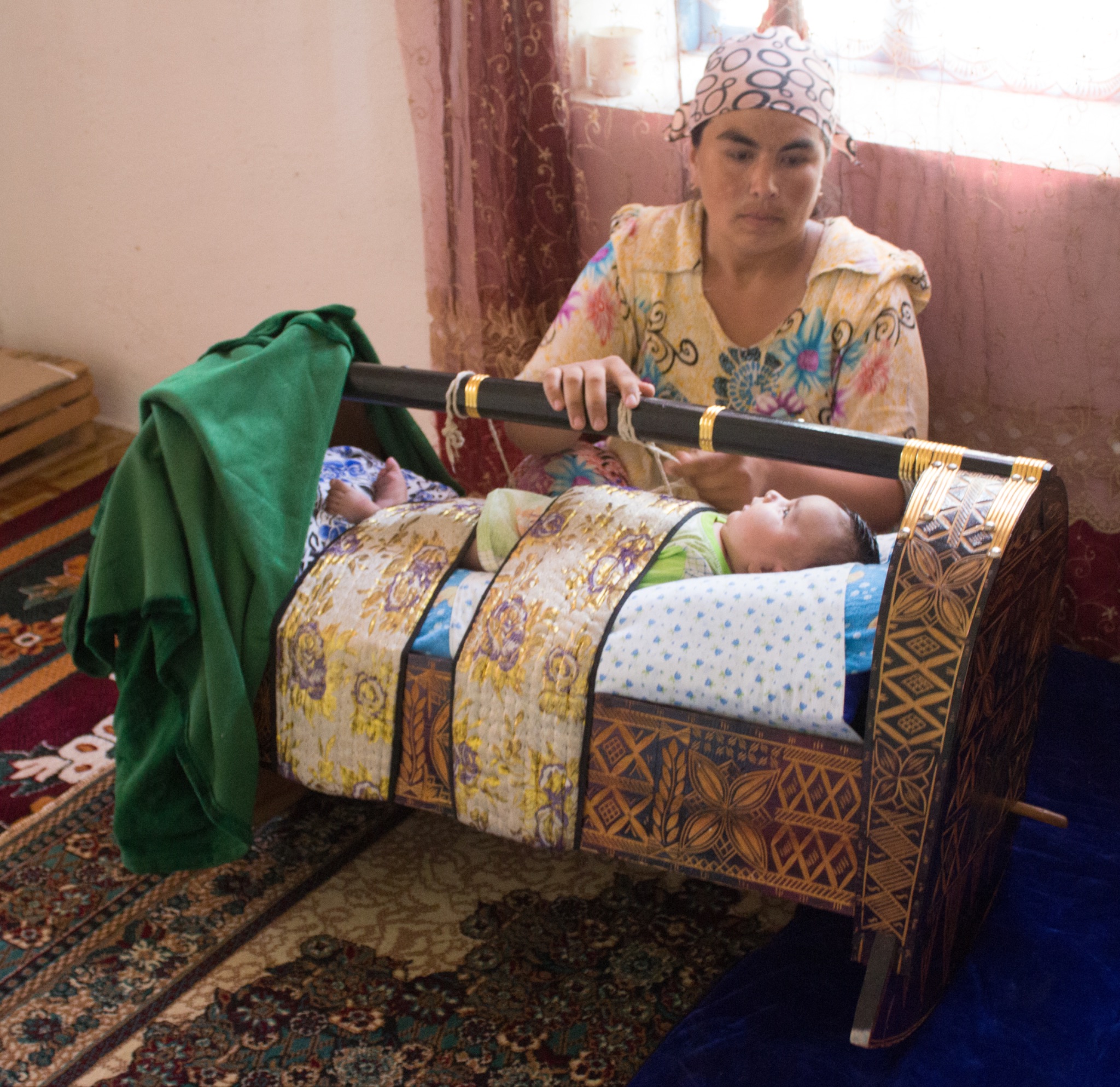
Figure 1. Infant in a traditional gahvora cradle.
That question is exactly what we set out to answer. Karasik, Robinson, and Dodojonova (2026) brought a classic paradigm into Tajik homes: the mobile conjugate reinforcement task. A ribbon attaches one of the baby’s ankles to a colorful mobile overhead. Kick that leg, and the mobile moves. Within minutes, most babies figure it out and start kicking more deliberately—this reflects contingency learning, the basic cognitive capacity to connect actions with consequences. Typically, 80–90% of three-month-olds in North American samples learn the contingency in a single session (Rovee-Collier, 1997). What about gahvora-reared infants, who have spent almost their entire lives with their limbs bound? They learned it too! Despite their history of dramatically restricted movement, in a single session, Tajik infants increased their kicking across acquisition (with the ribbon attached), selectively kicking the tethered leg more than the untethered one. They also kept kicking at high rates even after we disconnected the ribbon—a hallmark of contingency learning. Finally, when the ribbon was detached, they protested—via negative vocalizations—just like babies growing up with full freedom of movement do (Fagen & Ohr, 1985). In sum, Tajik babies formed real expectations about what their kicks would produce, despite having a fraction of the unrestricted movement time of a typical Western baby.
The Timing Wrinkle and What It Reveals
One nuance in our findings illuminates just how the gahvora shapes learning. Infants naturally varied in how long they had been out of the cradle just before the task, from a few minutes to over an hour. Infants released right before the task barely moved during baseline—some hardly at all—while babies who had been free to move for a while were already kicking and vocalizing. But here’s the key finding: By the end of the session, both groups had learned equally well. Infants who started slowly needed time to get into the rhythm of free movement before they could exploit the contingency, but once they did—within minutes—their kicking spiked and stayed elevated through extinction. This very slight delay is not a failure of learning; it’s recalibration to an environment in which movement is newly unrestrained. As in Western infants faced with other motoric challenges (shoes, backpacks; Adolph & Avolio, 2000; Cole et al., 2014), the period of adjustment to new motor demands in Tajik infants happens fast, but it is not immediate.
What This Means for Parents (and for Developmental Science)
These findings shed light on a puzzle: Why do gahvora-reared infants show no long-term motor lags despite such extensive early restriction (Karasik et al., 2023, 2024), when, for example, orphanage-reared infants—who also experience restricted movement—show persistent delays (Gunnar, 2001)? The difference may not be the movement restriction itself, but the caregiving context that surrounds it. Whereas orphanage-reared infants often lack consistent, responsive caregivers altogether, gahvora-reared infants have dedicated caregivers who consistently attend to their signals and interact with them, both inside and during their windows outside the cradle.
This carries a message that runs counter to the assumptions underlying Baby Einstein and other super-enrichment schemes. Contingency learning—one of the foundational building blocks of cognitive and social development—doesn’t require months of unrestricted movement to kick in. It activates quickly whenever infants get the chance to act. What matters is not the sheer quantity of free movement, but whether infants have access to responsive caregiving and face real-world contingencies to act on the world when they are free to move. Quality over quantity.
A Word to Anxious Parents
Our findings have practical implications that deserve to be said plainly. If you’re not filling every waking moment with enrichment activities, your child is still going to learn to reach, to kick, to roll, to walk—and to figure out how the world responds to their actions. Babies don’t need a full-time event planner!
But the deeper point is not just that limited movement is harmless—it’s that infants are resourceful learners who adapt to what’s available. When one channel for exploration narrows, others stay open—watching, listening, tracking the social world. When free movement resumes, recalibration is fast. These aren’t moments lost; they’re moments spent differently.
The Baby Einstein hypothesis assumes that development is a bank account: the more you deposit, the richer the child. But it doesn’t work that way. Development doesn’t require optimization at every moment. What it requires is sufficient opportunity: some time to move, some time to interact with a responsive caregiver, and self-generated actions that produce meaningful consequences. Beyond that threshold, more is not necessarily better. Enough is enough.
Transporting a classic learning paradigm into homes halfway around the world, and discovering that infants defy our assumptions about what they need to thrive, requires sustained investment in basic developmental science. This work was funded by the National Science Foundation, and it is exactly the kind of question-driven, cross-cultural research that federal funding makes possible.
References
Adolph, K., & Avolio, A. (2000). Walking infants adapt locomotion to changing body dimensions. Journal of Experimental Psychology: Human Perception and Performance, 26(3), 1148–1166. https://doi.org/10.1037/0096-1523.26.3.1148
Adolph, K. E., & Hoch, J. E. (2019). Motor development: Embodied, embedded, enculturated, and enabling. Annual Review of Psychology, 70, 141–164.
Campos, J. J., Anderson, D. I., Barbu-Roth, M. A., Hubbard, E. M., Hertenstein, M. J., & Witherington, D. C. (2000). Travel broadens the mind. Infancy, 1, 149–219.
Cole, W. G., Gill, S. G., Vereijken, B., Adolph, K. E. (2014). Coping with asymmetry: How infants and adults walk with one elongated leg. Infant Behavior and Development, 37, 305-314.
Fagen, J. W., & Ohr, P. S. (1985). Temperament and crying in response to the violation of a learned expectancy in early infancy. Infant Behavior and Development, 8, 157–166.
Gunnar, M. R. (2001). Effects of early deprivation: Findings from orphanage-reared infants and children. In C. Nelson & M. Luciana (Eds.), Handbook of developmental cognitive neuroscience (pp. 617–629). MIT Press.
Karasik, L. B., Tamis-LeMonda, C. S., Ossmy, O., & Adolph, K. E. (2018). The ties that bind: Cradling in Tajikistan. PLoS ONE, 13, 1–18.
Karasik, L. B., Adolph, K. E., Fernandes, S. N., Robinson, S. R., & Tamis-LeMonda, C. S. (2023). Gahvora cradling in Tajikistan: Cultural practices and associations with motor development. Child Development, 94, 1049–1067.
Karasik, L. B., Schneider, J. L., Kuchirko, Y. A., & Dodojonova, R. M. (2024). Object play in Tajikistan: Infants explore objects despite bounds on play. Infancy, 30, e12627.
Ramey, C. T., & Ramey, S. L. (1998). Early intervention and early experience. American Psychologist, 53, 109–120.
Rovee-Collier, C. K. (1997). Dissociations in infant memory: Rethinking the development of implicit and explicit memory. Psychological Review, 104, 467–498.
Zimmerman, F. J., Christakis, D. A., & Meltzoff, A. N. (2007). Associations between media viewing and language development in children under age 2 years. Journal of Pediatrics, 151, 364–368.
About the Author

Lana B. Karasik, PhD
College of Staten Island & The Graduate Center, City University of New York
Lana is Professor of Psychology at the College of Staten Island and the Graduate Center, CUNY. Her research examines how motor development shapes—and is shaped by—infants’ social worlds, with a particular focus on how cultural practices influence developmental trajectories. She leads cross-cultural longitudinal studies, including NSF-funded fieldwork in Tajikistan, investigating how traditional cradling practices affect motor, cognitive, and social development in infancy. Her work challenges deficit-model assumptions about non-Western childrearing and uses naturally occurring cultural variation as a window into the conditions that support early learning.

Scott R. Robinson, PhD
Pacific Ethological Laboratories, Olympia, Washington

Rano Dodojonova, MA
Republican Scientific and Clinical Center of Pediatrics, Dushanbe, Tajikistan
Rano is a Lead Researcher who has been a core collaborator on the Tajikistan infant development research program since 2013. Her work bridges developmental science and community engagement—she leads recruitment, coordinates longitudinal home visits across Tajikistan, supervises local research teams, and serves as the primary liaison between families and the U.S.-based research team. She brings deep expertise in the cultural and social context of Tajik family life, multilingual fluency in Tajik, Russian, English, and Uzbek, and a parallel commitment to disability rights and gender equity in Central Asia.