
When it comes to babies’ social worlds, one size does not fit all.
Even within the first year of life, infants differ in how their brains respond to social information, such as facial expressions, eye contact and speech. Rather than all babies attending to social cues in the same way, each infant appears to have their own unique pattern of neural engagement. Novel AI-based methods can now be used to personalise brain science and track these individual patterns in real time. This allows us to ask a simple but powerful question: what does each baby’s brain find most engaging in a social exchange?
Studying baby brains, one baby at a time
Traditionally, infant research has focused on group averages. While this approach has taught us a great deal, it can sometimes miss something important: individual differences. To address this, researchers at the Centre for Brain and Cognitive Development at Birkbeck, University of London used a cutting-edge method called Neuroadaptive Bayesian Optimisation (NBO), an artificial-intelligence technique that adapts in real time to each baby’s brain activity1,2.
In a pre-registered study involving 61 infants aged 5 to 12 months3, babies looked at images of their caregiver’s face, a stranger’s face, or faces that were a mix of both. While babies viewed the faces, we recorded brain activity using electroencephalography (EEG), a safe and non-invasive technique (see Figure 1). We then used a machine learning algorithm that learned from each baby’s brain responses as the experiment unfolded. After each image was shown to the baby, the algorithm estimated which face had sparked the strongest response and used that information to choose what image to show next, allowing us to adjust the experiment moment by moment to each infant’s brain signals. This approach helped us identify which type of face triggered the strongest response for every individual baby.
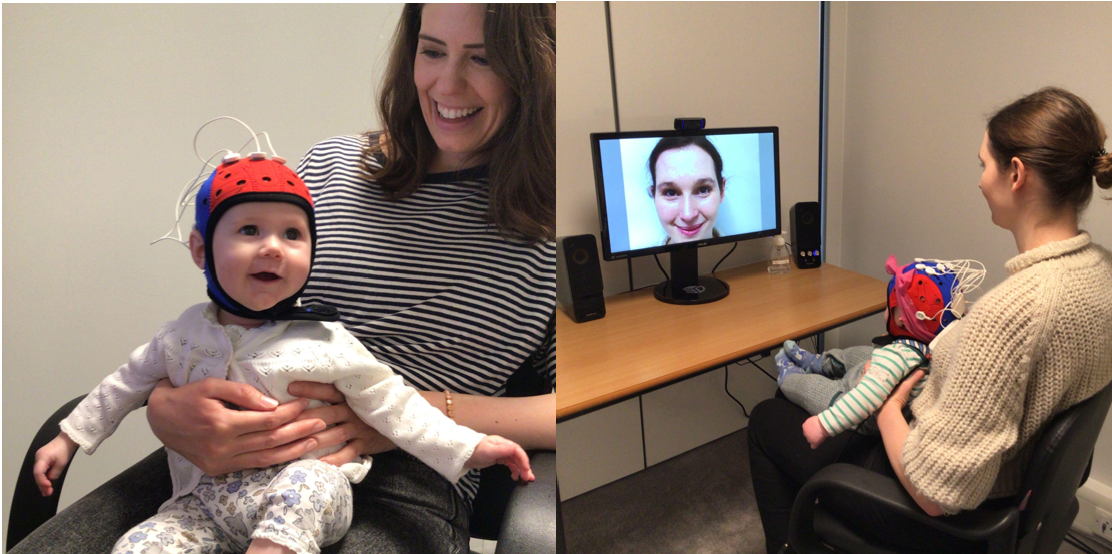
Figure 1. Baby participants wearing EEG caps that measure their brain activity while they view images of different faces on a screen.
No “average” baby brain
What did we find? There was no single face type that worked best for all babies. Instead, around 85% of infants who completed the study showed strong individual preferences, with different babies responding most strongly to different faces.
An added bonus? This personalised approach also led to lower drop-out rates (about 15%, compared to the 22% typically seen in infant EEG studies). This demonstrates how tailoring experiments to babies by presenting images that elicit the strongest brain response can help keep them engaged.
The BONDS project: personalised approaches to social development
These findings are part of the wider BONDS project (Behaviour and Online Neuroimaging to study the Development of Socialisation), which involved over 120 infants and their families. BONDS combines wearable neuroimaging with artificial intelligence to test what social cues individual babies’ brains attend to.
A recent pre-registered study4 extended this work by showing that infants’ brains are sensitive to different combinations of social cues, such as eye gaze, head orientation, and emotional expression, and that the most engaging combinations vary from baby to baby.
Further, BONDS research has shown that personalised methods can be used not only with images on a screen, but also during live social interactions with an experimenter5. These studies demonstrate that:
- Infants differ in which social signals (e.g., gaze, infant-directed speech) elicit the strongest neural responses
- Brain engagement during social interaction reflects how motivated and attentive infants are in that moment
- Individual neural preferences can be detected reliably, even in dynamic, real-world social situations
Together, these findings suggest that early social brain development is shaped by individual experience and neural tuning, rather than following a single “typical” pattern.
Follow the baby’s lead
In summary, we showed, with a set of rigorous neuroimaging studies, that babies naturally differ in what captures their attention. Some may be especially drawn to expressive faces or direct eye contact, while others respond more strongly to subtler social cues. Because infants differ in what captures their attention, using personalised neuroimaging approaches to study these early differences in interests could open up new ways to support responsive parenting — that is, noticing what a baby naturally attends to and responding to it. Tuning into these individual preferences may help nurture babies’ attention and emerging social skills.
Looking ahead
By using personalised neuroimaging approaches, researchers are gaining a richer understanding of how babies engage with others from the very start of life. This work highlights the importance of recognising and respecting individual differences in early development — both in science and in everyday parenting.
The BONDS project is now expanding beyond infancy to study neurotypical and autistic toddlers, focusing on how children interact with their parents during real social exchanges. By studying parent–child interaction at this stage, the project aims to capture how diverse developmental pathways unfold, and how personalised approaches can help us understand and support children with different strengths and needs.
To learn more about this research and future findings, visit the BONDS project website: https://sites.google.com/view/bonds-project/
References:
- Lorenz, R., Hampshire, A., & Leech, R. (2017). Neuroadaptive Bayesian optimization and hypothesis testing. Trends in cognitive sciences, 21(3), 155-167.
- Gui, A., Throm, E. V., da Costa, P. F., Haartsen, R., Leech, R., & Jones, E. J. (2022). Proving and improving the reliability of infant research with neuroadaptive Bayesian optimization. Infant and Child Development, 31(5), e2323.
- Throm, E., Gui, A., Haartsen, R., da Costa, P. F., Leech, R., Mason, L., & Jones, E. J. (2025). Combining Real‐Time Neuroimaging With Machine Learning to Study Attention to Familiar Faces During Infancy: A Proof of Principle Study. Developmental Science, 28(1), e13592.
- Gui, A., Throm, E., da Costa, P. F., Penza, F., Mayans, M. A., Jordan-Barros, A., Haartsen, R., Leech, R., & Jones, E. J. H. (2024). Neuroadaptive Bayesian optimisation to study individual differences in infants’ engagement with social cues. Developmental Cognitive Neuroscience, 68, 101401.
- Throm, E., Gui, A., Haartsen, R., da Costa, P. F., Leech, R., & Jones, E. J. (2023). Real-time monitoring of infant theta power during naturalistic social experiences. Developmental Cognitive Neuroscience, 63, 101300.
About the Author

Anna Gui, PhD
University of Rome Tor Vergata
Anna is a developmental researcher interested in the neurobiological mechanisms underlying individual differences in infant behaviour. She works with large-scale genetic datasets and lab-based individualised neuroimaging approaches to identify early signs of atypical developmental trajectories and help devise evidence-based personalised support for families of neurodiverse children.
LinkedIn: linkedin.com/in/anna-gui-92732aa0
ORCID: https://orcid.org/0000-0003-1108-0774

Antonia Jordan-Barros
Birkbeck, University of London
Antonia is a PhD student at the Centre for Brain and Cognitive Development, Birkbeck, University of London. Her PhD, funded by the Medical Research Council UK, examines the early cognitive development of neurodiverse children by investigating which social activities maximise neural engagement in autistic and non-autistic toddlers. Prior to her PhD, Antonia conducted research on the development of language and communication skills from infancy to pre-school age.
LinkedIn: https://www.linkedin.com/in/antonia-jordan-barros-0843351a5/
ORCID: https://orcid.org/0009-0003-2890-0027
Emily Jones, PhD
Birkbeck, University of London & King’s College London
Emily is Professor of Developmental Translational Neuroscience at King’s College London and Birkbeck’s Centre for Brain and Cognitive Development. Her research explores the brain and cognitive processes that shape early development, especially attention, memory, and social engagement in infants and young children, and how these processes vary across typical and atypical development. She leads longitudinal and collaborative studies, including work on autism and early neural differences, and develops innovative methods to understand how early experiences influence lifelong learning and behaviour.
LinkedIn: linkedin.com/in/emily-jones-0b809570
ORCID: https://orcid.org/0000-0001-5747-9540