
Previous research has shown that infant and adult preferences may in fact align. Infants are sensitive to low-level statistics— visual attributes of scenes or images consisting of properties such as edges, colours, and textures. Research has found that infants are sensitive to and prefer to look at certain image statistics over others (Newman et al., 2025). For example, in one study, infants tended to look longer at Van Gogh paintings that had a high variation in saturation and luminance (McAdams et al., 2023). Adults also tended to rate such paintings as being the most ‘pleasant’, displaying a shared preference for the same artworks that babies liked to look at. The authors tentatively suggested that these low-level image statistics that contributed to both infant visual preferences and adult pleasantness ratings are a form of ‘perceptual primitives’— the origins of aesthetic preference. Similar positive relationships between infant looking and adult aesthetics have been found for faces (Damon et al., 2019), colour (Skelton & Franklin, 2020), and building facades (McAdams et al., 2025).
In our research, we further investigated the relationship between infant looking and adult liking using baby book images. There is much evidence to suggest that early engagement with books is good for language acquisition (Franks et al., 2022), as well as social and emotional development (Briggs-Gowan, 2004). However, what kinds of books are most visually engaging for young babies, and are those books typically the ones that adults also like? We showed 54 infants (aged 2-12 months) 100 pages from baby board books across two experiments. A sample of 18 adults (aged 19-40 years) was also included in the second experiment. Infants were eye-tracked and their looking times, number of fixations, and saccade amplitudes were measured. Adults were also asked to rate the images on a sliding scale between 0 and 100, ranging from “I do not like at all” (0) to “I like a lot” (100). Scanned images of the book pages (see figure 1) were presented centrally on the screen, with the rating scale appearing below the stimuli in the adult experiment. The low-level image statistics of the book pages were also computed and were chosen based on their usage in previous research on both adult aesthetics (Berman et al., 2014) and infant looking behaviours (McAdams et al., 2023). These included saturation, luminance, straight and curved edge density, the proportion of different hues, and more (see figure 1 for examples).
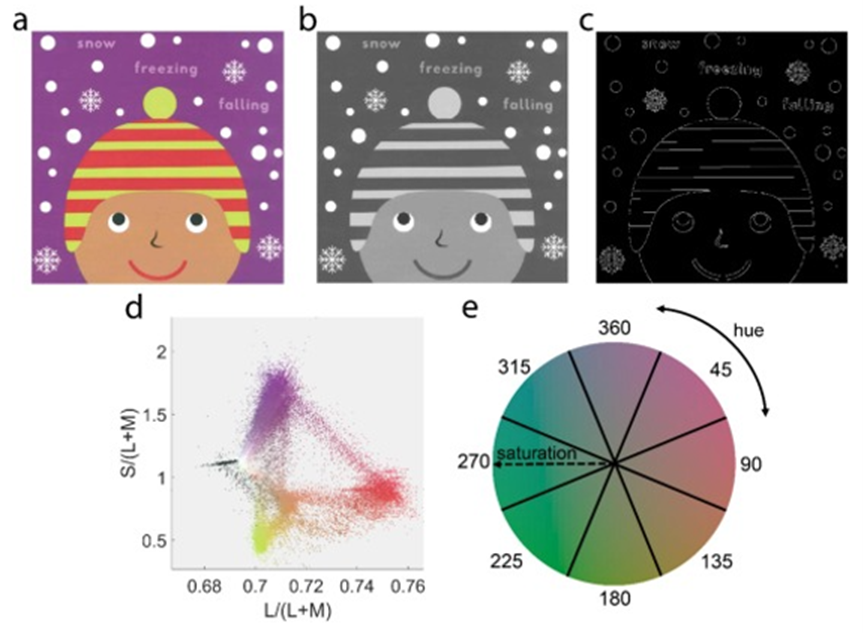
Fig. 1. Examples of the image statistics used in the study (a) A book page used as a stimulus in Experiment 2 (Look Touch Learn Sky © 2022 Child’s Play (International) Ltd.), (b) The luminance matrix of the book page, (c) the edges of the book page highlighted by image analysis, (d) the pixel chromaticity plotted in the MacLeod & Boynton (1979) colour space, (e) the 8 hue segments (and the mean hue angles: 45°, red; 90°, cherry; 135°, yellow; 180°, chartreuse; 225°, green; 270°, teal; 315°, blue; 360°, violet) used to compute the mean saturation and proportion of pixels of different hues, with the dimension of saturation also shown. Figure from Newman et al. (2026).
Infant visual engagement in experiments one and two and adult liking ratings shared common predictors: variation in saturation, saturation of cherry and red hues, mean luminance, mean saturation, entropy, curved edge density, and fractal dimension. However, interestingly all predictors were in opposite directions for infants and adults. For example, infants visually engaged more with book pages that had a higher saturation, more colour contrast, more bluish hues, and a lower edge density, whereas adults liked these pages less.
In fact, infants were the most visually engaged with book pages that adults liked the least (see figure 2). Likewise, while pages with desaturated colours or black and white designs, low contrast, visual complexity, and detail were the most well-liked by adults, infants tended to visually engage with them the least.
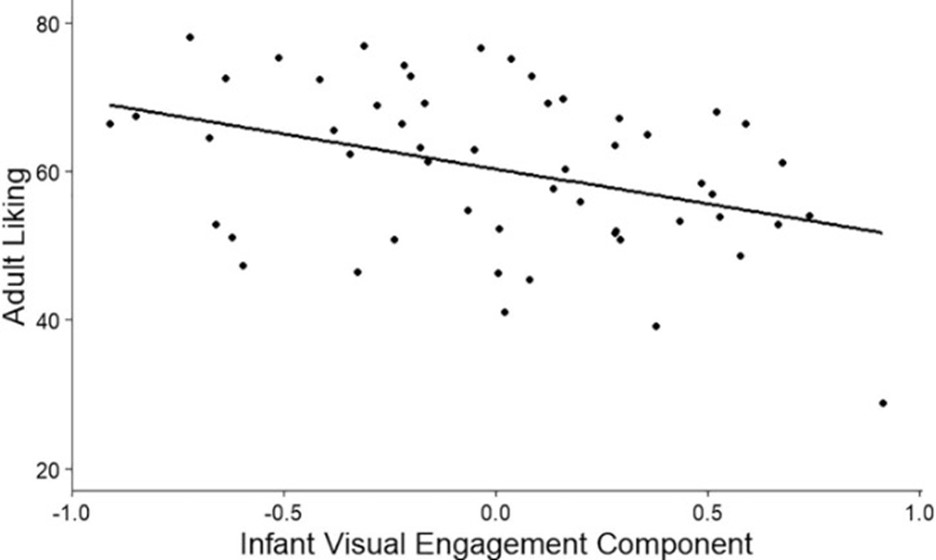
Fig. 2. Scatterplot showing the relationship between the infant visual engagement principal component and adult liking ratings for each book page (each page is indicated by a black dot). The black line indicates the line of best fit. Figure from Newman et al. (2026).
While these results can act as a guide for baby book publishers, there are also implications for our understanding of what underlies infant visual preferences. Infant engagement and adult liking sharing common predictors echoes the notion of the ‘perceptual primitives’ of aesthetics. However, unlike previous research infants and adults responded in opposite ways for book images. These differences in infant visual preference and adult aesthetic preferences may be a result of infants’ immature visual system (Norcia & Tyler, 1985). While infants have functional colour vision by at least two-months-old (Teller, 1998), colours need to be highly-saturated to be visible to them. Infants’ poor visual acuity and colour sensitivities are not yet sufficient enough to properly engage in images with high detail and pastel colours, yet high contrast black and white designs may in fact be too ‘easy’ given that infants have colour vision, which may explain why infants visually engage the most with book pages that are highly colourful.
About the Author

Taysa-Ja Newman
The Sussex Baby Lab
Taysa first joined The Sussex Baby Lab in 2022 as a research assistant where she investigated infant visual preferences of natural scenes. She is now a doctoral researcher in the Nature and Development Lab after completing her undergraduate degree at the University of Sussex. Previously exploring how infants engage with baby board books using eye-tracking, she is currently researching the effects nature may have on infants’ stress, cognition, and development.

Prof. Anna Franklin
Sussex Colour Group
Professor Anna Franklin leads the Sussex Colour Group and co-leads the Sussex Baby Lab. She joined Sussex in 2011 following a visiting scholarship at the University of California, Berkeley, and a faculty position at the University of Surrey. She has conducted research on colour for the last 25 years, leading projects that ask questions about how we see and think about colour across development as well as in adulthood. She was a recipient of an ERC Starting Grant (Project CATEGORIES) and an ERC Proof of Concept Grant (Project COLOURTEST) and is currently leading an ERC Consolidator Grant (Project COLOURMIND). She regularly consults for industry and has led commercially funded projects which apply the science of colour and perceptual development to product design.

Dr Philip McAdams
Indiana University
Dr Philip McAdams is a Postdoctoral Fellow in the Cognitive Development Lab at Indiana University, and School Associate at University of Sussex. His work shows that properties such as fractal dimension, edges, and colours predict how long infants look at art, natural scenes, patterns, and baby books, offering insight into how visual perception tunes to the environment during infancy and the development of aesthetics. These findings have informed industry product design. He also helped create a large egocentric-image dataset from head-mounted cameras worn by infants in daily life, revealing how visual diet and everyday experience shape visual development.